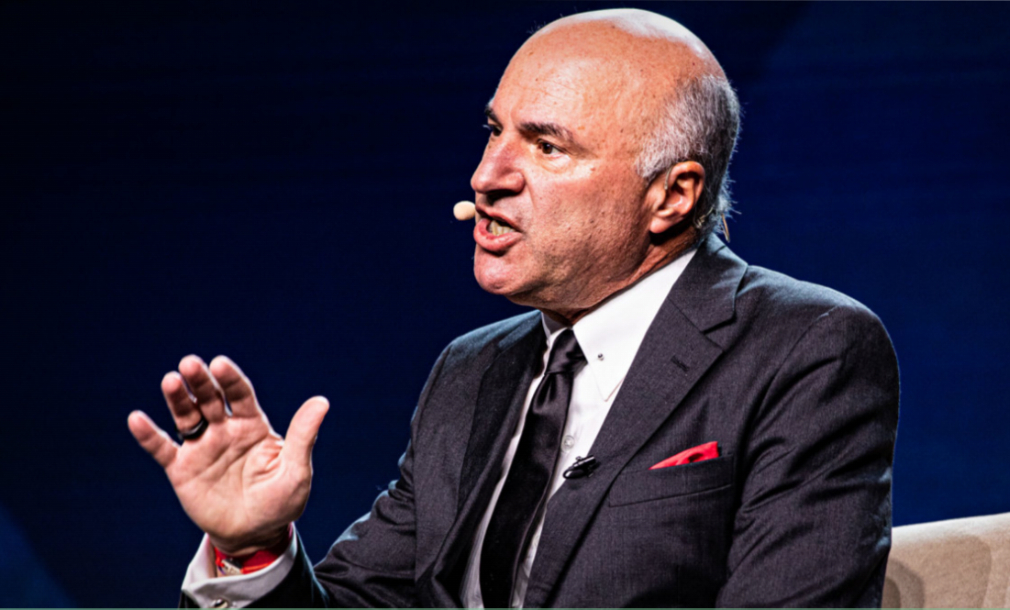
Kevin O’Leary has spent decades cultivating one of the most recognisable personalities in business television. To millions of Shark Tank viewers, “Mr. Wonderful” is the investor who rarely hesitates, dislikes excuses and is perfectly comfortable telling an entrepreneur that an idea simply isn’t going to work.
Advertisement
That image has made O’Leary famous, but it has also concealed a more complicated story. In a series of recent appearances, the Canadian businessman has spoken more openly about decisions from his past, including failures, difficult relationships and moments when his confidence did not necessarily produce the right answer.
At the same time, O’Leary has begun changing some of his investment positions. He is again putting money into cryptocurrency and has acknowledged that some of his earlier assumptions about the development of blockchain technology were wrong.
Taken together, the comments offer a somewhat different picture of the businessman audiences thought they already knew.
A Different Side of Kevin O’Leary
During a lengthy conversation with fellow Shark Tank investor Daniel Lubetzky, O’Leary discussed subjects that rarely appear during his television appearances. The conversation moved from entrepreneurship into his childhood, marriage, friendships and some of the decisions he made before becoming wealthy.
One particularly personal story concerned his relationship with Linda, the woman he would later marry. O’Leary discussed being unfaithful while they were engaged and having to confront the possibility that the relationship could end.
The couple ultimately remained together and married, but O’Leary’s decision to discuss the episode publicly decades later provided an unusual glimpse behind his carefully constructed television persona.
The significance of the story was not that some previously hidden scandal had suddenly been uncovered. O’Leary himself chose to discuss it. What made it interesting was hearing someone whose public philosophy revolves around discipline and rational decision-making describe an occasion when his own behaviour nearly cost him one of the most important relationships in his life.
Success Also Cost Him a Friendship
O’Leary also revisited another painful decision from the early stages of his business career.
Before television and celebrity transformed him into Mr. Wonderful, he was attempting to build a software company. Like many young entrepreneurs, he worked with people he already knew and trusted. Eventually, however, he concluded that one of those relationships was no longer working professionally.
The person involved was his best friend.
O’Leary ultimately fired him.
It is the kind of decision that sounds straightforward when reduced to the philosophy he frequently presents on television: if somebody is preventing a company from succeeding, the needs of the business must come first. Living through that decision was more complicated.
The episode helps explain why O’Leary later became so uncompromising about separating personal relationships from business decisions. Some of the lessons he now delivers to entrepreneurs were not developed in a television studio. He learned them through experiences that carried consequences long after the immediate business problem disappeared.
Long Before the Money, His Future Looked Very Different
O’Leary’s path to wealth was also far less obvious than his later success might suggest.
As a young man, he was deeply interested in photography and initially imagined building a future around it. His stepfather challenged that ambition and questioned whether photography could provide the kind of career O’Leary wanted.
Eventually, O’Leary changed direction. He pursued business studies and later founded SoftKey Software Products in Toronto.
SoftKey expanded through acquisitions and eventually became The Learning Company. In 1999, Mattel acquired the business in a multibillion-dollar transaction.
That deal helped establish the financial foundation for the career that followed, although the acquisition itself later became notorious for Mattel after the business performed badly under its ownership.
For O’Leary, however, the experience reinforced a philosophy that still appears throughout his public comments: changing direction is not necessarily an admission of defeat. Sometimes refusing to change is the more expensive mistake.
That Philosophy Is Appearing Again
More than two decades later, O’Leary is applying essentially the same principle to cryptocurrency.
He recently disclosed that he has begun buying digital assets again after pulling back during a difficult period for the market. He described himself as being “back in the saddle,” signalling renewed interest in the sector.
More interestingly, O’Leary has acknowledged that his understanding of where blockchain technology was heading has changed.
Around a year and a half earlier, he expected Ethereum to become the dominant infrastructure around which much of the industry would consolidate. He no longer appears convinced that the future will be that simple.
Instead, O’Leary now expects different blockchain networks to compete for different institutional applications. Banks, exchanges and other financial institutions could ultimately determine which technologies become important by deciding which networks they actually use.
For an investor known for speaking with extraordinary confidence, the admission is notable. O’Leary is effectively acknowledging that his original thesis did not develop exactly as expected — and adjusting his money accordingly.
O’Leary Is Betting on a Much Bigger Transformation
His renewed interest in digital assets does not mean he is simply betting on another speculative cryptocurrency boom. O’Leary has increasingly framed blockchain as infrastructure that could eventually become integrated into conventional finance.
He has suggested that digital assets could evolve into something resembling another major sector of the financial system rather than remaining an isolated market dominated by speculation.
That possibility is central to his current investment thesis. If major financial institutions begin moving settlement, payments or other services onto blockchain networks, the companies providing that infrastructure could become substantially more important.
There is no guarantee that O’Leary’s prediction will prove correct. He has changed his mind about the sector before, and the cryptocurrency market remains exceptionally volatile.
But that uncertainty does not appear to bother him. In fact, it is often precisely what attracts him.
His Biggest Bets Are Already Creating Controversy
Cryptocurrency is only one part of O’Leary’s current strategy. He has also become increasingly involved in enormous artificial-intelligence infrastructure projects, particularly data centres capable of supplying the computing power required by AI companies.
Those ambitions have not developed without resistance.
A proposed data-centre development associated with O’Leary in Utah generated opposition from residents concerned about electricity consumption, water use and the environmental consequences of such a large project.
O’Leary responded aggressively to some of the criticism. He suggested that outside interests could be encouraging opposition and made claims about protesters being paid to participate. Reporting subsequently challenged those allegations, and O’Leary acknowledged that he did not possess evidence tying specific protest organisations to such activity.
The episode was a reminder that the uncompromising style that works extremely well on television can produce very different consequences when billions of dollars, local communities and major infrastructure projects are involved.
The Public Image and the Private Reality Are Not Always the Same
This is what makes O’Leary’s recent comments particularly interesting.
For years, audiences have seen a carefully defined version of him. Mr. Wonderful understands money. Mr. Wonderful does not tolerate weakness. Mr. Wonderful makes the decision and moves on.
His own recollections reveal something more complicated.
O’Leary has made personal decisions he regrets. He has ended professional relationships that were personally important to him. He has pursued ideas that did not work. He has changed investment theses after discovering that the market was developing differently from what he expected.
None of that undermines his success. If anything, it helps explain the philosophy he developed from it.
O’Leary’s real advantage may not be that he is always right. It may be his willingness to abandon a position once he concludes that being right about it no longer matters.
There Is No Secret Leak — But There Are Real Revelations
That distinction is important because some of the more dramatic claims circulating around celebrities and business figures can easily create a misleading impression.
There is no verified evidence of a secret scandal about Kevin O’Leary that was concealed for more than a year and suddenly leaked. There is also no confirmed personal tragedy involving him behind these recent reports.
What has actually happened is subtler.
O’Leary himself has become more willing to discuss parts of his history that rarely fitted the Mr. Wonderful character, while simultaneously revealing changes in where he believes some of the biggest investment opportunities now exist.
Those two developments make the current moment interesting without requiring an invented scandal.
Kevin O’Leary Is Still Taking Risks
At 72, O’Leary is not behaving like a businessman preparing to quietly step away.
He continues to invest, remains involved in major AI infrastructure proposals and is again allocating money to digital assets. He is also still willing to make predictions that could eventually prove either remarkably prescient or completely wrong.
But his recent comments make the story more human than the familiar television version.
The businessman who built a career telling other people that mistakes have consequences has made plenty of his own. The investor famous for certainty has changed his mind repeatedly. And the television personality who appears almost entirely unemotional can still recall decisions from decades ago because of what they cost him personally.
Perhaps that is the more interesting truth about Kevin O’Leary.
His career was not built by avoiding every mistake. It was built by surviving them, deciding what they taught him and being willing to change direction when the evidence no longer supported the original plan.
And despite decades of success, O’Leary is still doing exactly that.